
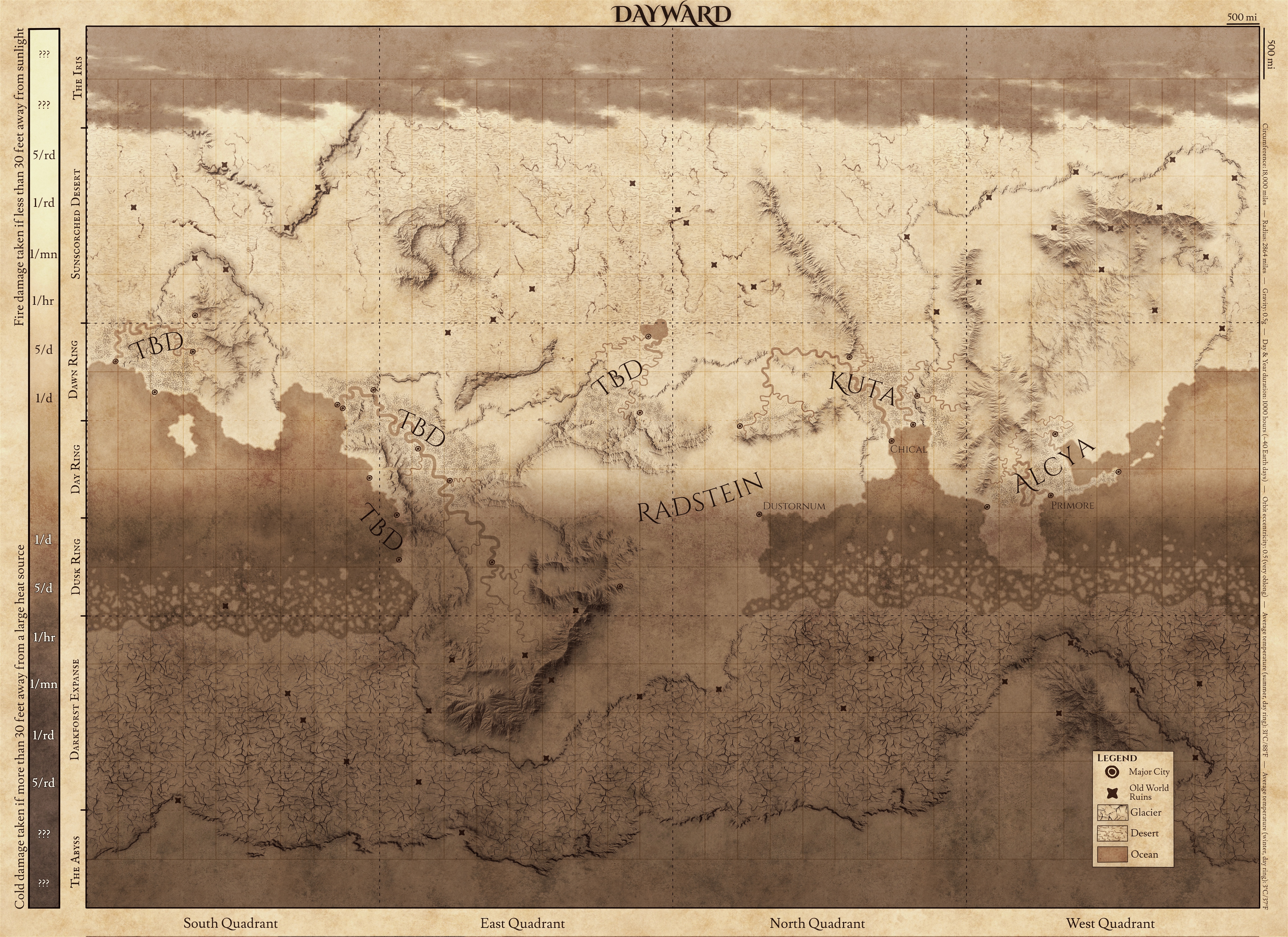
After the Daybreak, a magical cataclysm 60 years ago, the world of Olira stopped spinning. One side of it has become a scorching hot desert, and the other is a permanently dark glacier. Most people live on the thin strip of temperate lands between the two sides, but the player characters are “Shadeseekers”: brave travellers who rebuild the world by linking isolated outposts with one another, or exploring pre-daybreak ruins to retrieve lost artifacts of the old world.
Mechanically, the setting is about:
-Survival: the book assumes the use of the gritty realism optional rules (short rests take 8 hours, long rests take 7 days).
-Travel: this is a book for GMs who want to run adventures about travel, and not just adventures involving travel.
-Vehicles & Mounts: travel & vehicles often go hand in hand, so the book provides a solid set of rules in an attempt to make vehicle combat both fun and easy to run.
The book is to be funded through Kickstarter, printed through Amazon.
It will be published under the Open Gaming Licence.
I am looking for one editor, and a team of writers & designers to bring this book to life.
If this sounds like something you’d like to get involved with, keep reading!

Who am I
I am Valentin “Trekiros” Prévost (he/him), some 29 years old French idiot who’s trying to sell you on his next project.
I have several years of experience as a project manager as part of my day job (software engineering), and have had game design as a hobby my entire life.
I was the project lead for Home-Field Advantage, a book which ended up becoming a Mithral Best Seller and winning an ENnie Award for Best Monster/Adversary supplement of 2022.
With my own expertise, as well as the guidance of established creators around me, I am confident I can successfully lead this project, and make it a great book, as well as a smooth experience for all involved.

Project timeline
Applications are open from now until [TODO]. You will be pitching ideas for the book, and I will get back to every single applicant to let them know whether or not one or more of their pitches was accepted within 2 weeks after the applications close.
The project will be launched on Kickstarter in Q1 2023. The Kickstarter demo will only feature content I have written myself, as a way to reduce up-front costs.
If the Kickstarter campaign succeeds, the project will kick off for all writers. It will happen in two rounds: production, and revision (separated by a round of reviews & playtests). These two rounds should last until the end of Q2 2023.
Writers will be paid 33% on kickoff, 33% at the end of production, and 33% at the end of revision.
After revision, the book will need to be edited and laid out, and proof copies need to be verified. I expect post-production to take until Q3 of 2023.
Editors will be paid 50% at the end of revision, and 50% after submitting a finalized script.
More accurate deadlines will be communicated as the project advances. The deadlines are calculated on a basis of 1 week per 1000 words for writers, 1 week per 500 words for game designers, and 1 week for 5000 words for the editor, and then half that for the revision.

Compensation for Writers
Tasks will be compensated based on a basis of $0.10 per word for narrative writing tasks, and $0.15 per word for game design tasks.
You will be compensated based on the target word count of each task, not the word count in the final product. This is to encourage brevity, and discourage extreme verbosity. If you hit all of a tasks’ objectives in half the words I thought it would take you, more power to you!
Compensation for the Editor
On top of putting together a team of writers, I am looking for one editor. As the project’s editor, Your tasks will include:
-Making sure the text is in accordance with American English, the Chicago Manual of Style, and the WotC style guide
-Checking language for clarity, tone, consistency, style, and organization
-Making minor edits that preserve the author’s intent, and communicating with the author in case of substantive changes needed.
You will be compensated based on the number of words submitted pre-editing. You will be given chunks of 10-25k words (the demo will be ~20k words, and the main goal and stretch goals are about 40k words each), and paid half before starting work, and half when the work is complete.
Referral Links
If you have an established audience, I can provide a referral link so you can help with the marketing of this project.
This link will track the pledges you bring to the Kickstarter campaign. After the campaign completes, you will be compensated for 20% of the pledges made with your link.
Etiquette
By applying to this project, you agree to the following code of conduct: https://www.drivethrurpg.com/product/315105/Code-of-Conduct-for-RPG-Projects
Feedback:
Giving or receiving unsolicited feedback that is not strictly necessary for the book’s completion can, understandably, be difficult. For this reason:
-At any point during or after the project, you are free to ask for recommendations or feedback from me as the project lead. I will give you this feedback privately first, and then, should you wish to, I can then publish that feedback publicly.
-Should you wish to give feedback related to this project, know that I am always looking for negative feedback, personally. I am way too dumb to do good on my first try, without a bit of help from those with a different perspective.
-Should you wish for your feedback to be anonymous, a bot will be set up in the project’s Discord server for this purpose. You can also use the feedback form on the bottom left of my website.
Design Principles
Here are a few useful links for you to read through, so you can get an idea for the vibe of this setting, and a few of the original ideas that you will be able to bounce off of:
–40-page preview of the book (not final): [INSERT LINK HERE]
–Pre-launch Kickstarter Page (not final): [INSERT LINK HERE]
–Art Reference sheet: https://docs.google.com/…
On top of matching the vibe & themes established in these links, your submissions to the book will only be considered complete if they follow these design principles:
Interactivity. While worldbuilding is a fun activity, do not lose sight of the fact that this is a setting meant to be played in. The book is not intended to be a repository of lore for lore’s sake: its goal is to provide Game Masters with plenty of tools and adventure seeds, and provide players with plenty of character prompts. Every page should be designed to make the readers think “I want to play/run a game in this setting”, not “I want to read a novel in this setting”.
To achieve this, try to emulate the style in which Eberron is written, as this setting actively tries to facilitate people taking ownership of the setting. For example:
-Nobody knows what caused the Mourning, the books only provides a list of hypotheses. It is up to the GM to decide which hypothesis is true, or come up with their own secret cause for the players to discover throughout their adventures.
-Each Valenar Elf worships one illustrious ancestor with whom they share characteristics. Who that ancestor is, what those characteristics are, and what form does the worship takes, are all left up for the player to decide when they create their character (with some helpful prompts). Whatever they come up with becomes canon for the duration of their campaign.
Thematic Specificity. The elevator pitch at the top of this page outlines the core themes and premise of this book: a world which doesn’t spin, extreme hot and cold, post apocalyptic survival, travel & exploration, etc.
People who will buy this book will expect content which matches these themes. Therefore, if a concept or idea does not need any of these themes to exist, then this is probably not the right book to put that concept or idea in. It doesn’t mean the idea is a bad one, but it does mean that putting it in this book will betray the customers’ expectations.
Bad example: “Warlock Patron: the Archmage”
Better example: “Ranger Archetype: Sand Stalker”
Grokkability. People are much less likely to remember “Mel’fa-tharila’s” than “the Elven prison”. Therefore, tap into common knowledge, tropes, pop culture, etc… Whenever appropriate.
Of course, this does not mean use tropes in a way that is harmful to real, marginalized people, or to use pop culture in a way that infringes on intellectual property.
But keep in mind that simplicity and relatability are important for readers to find the book usable.
Available Tasks
Here are the tasks you can pitch ideas for if you are a writer or game designer. Below the table are definitions to help you understand the nature of each task. You can also find examples in the Kickstarter demo listed above of each type of task.
| Task | Target Word Count | Compensation (US $) | How many will the book include* | How many I will write myself |
|---|---|---|---|---|
| Country | 2000 | $200 | 10-20 | 5 |
| Faction | 500 | $50 | 5-10 | 4 |
| Biome | 500 | $75 | 15-25 | 10 |
| Race | 1000 | $150 | 2-4 | 2 |
| Subclass | 1000 | $150 | 4-8 | 2 |
| Vehicle | 500 | $75 | 5-10 | 3 |
| Mount | 200 | $30 | 5-10 | 3 |
| Magic Item – Simple | 100 | $15 | 8-16 | 5 |
| Magic Item – Medium | 200 | $30 | 5-10 | 3 |
| Magic Item – Complex | 500 | $75 | 2-4 | 2 |
| Monster – Solo | 500 | $75 | 10-20 | 5 |
| Monster – Family | 600 | $90 | 10-20 | 5 |
| Adventure | 5000 | $500 | 1-2 | 0-1 |
*: depends on how many stretch goals are reached
Countries
Countries must feature at least:
-1 city that might be interesting for adventurers to visit, including a short description and a list of plot hooks for this city
-2 to 4 factions within the country, each with a short description and some plot hooks. Note: most adventures tend to stay within the borders of one or two countries, so if all of the factions featured within a given country are allied and working harmoniously with one another, it would probably make for poor adventure hooks.
-2 to 4 backgrounds for player characters (at least one for each of the factions described)
-a list of names which fit the country’s language and culture
-a little something extra to make it stand out. A new form of magic? A national sport?…
Factions
Factions are groups the players would be likely to encounter, and maybe join. They can span multiple countries, unlike the factions listed within the “Countries” section of the book. They must feature a short description, and a table of plot hooks.
Biomes
Biomes feature a d20 table of encounter ideas (not d20 “monsters you can find here” – make sure to include non-combat encounters, and to make the combat encounters at least a little bit interesting), and a d20 table of plot hooks to give adventurers reasons to visit those biomes.
Here is the list of planned biomes, though you can also pitch ideas for biomes outside of this list:
Day Side:
-Scorched Plains (former plains, now desertic)
-Black Peaks (mountains with zero snow)
-Dried Ocean (former ocean, now exposed sea floor)
-Stranded Islands (former islands, now plateaus & mountains within the dried ocean)
-Volcanic Rift (former oceanic trench with heavy volcanic activity, now exposed)
-The Iris (permanent hypercane at the subsolar point)
Dawn Ring:
-Savanna (warm plains)
-Rainforest (warm forest)
-Salt Swamps (the biome between regular oceans & dried oceans)
Dusk Ring:
-Tundra (cold plains)
-Taiga (cold forests)
-Iceberg Sea (the biome between regular ocean & frozen ocean)
Night Side:
-Frigid Plains (former plains, now too cold for life)
-Everwhite Peaks (mountains, but extra-cold)
-Darkfrost Glacier (former ocean, now frozen over, with pockets of liquid water under the ice)
-Enclosed Islands (former islands, now surrounded by frozen oceans)
-Volcanic Hot Spot (volcanoes, one of the only warm spots where life can still exist)
-The Abyss (the antisolar point, the coldest & darkest region of the world)
Races & Subclasses
Each Race & Subclass must come with a d6 table of prompts for character creation (e.g. quirks, goals, patrons, deities, etc…) on top of the lore & mechanics.
Vehicles & Mounts
Each vehicle & mount is 1 stat block and some light lore. Priority will be given to vehicles & mounts which are tied to the lore of a country.
Magic Items
Magic items are divided by complexity: simple, medium, complex. Note that this is different from rarity or power: you can have simple legendary weapons, and complex uncommon magic items.
Stat blocks
Stat blocks are divided into solo monsters, and monster families. Monster families include 3 to 5 stat blocks with largely shared lore, for example different versions of the same monster at different stages of its life, or a monster and the swarm version of that monster.
Adventures
The adventures should be either a 2-4 hours one shot, or a short ~10-20 hours campaign. These adventures should use & reference content from the book (towns, vehicles, monsters, biomes & their random encounters, etc…), and as a result the body of the adventure itself should only contain plot-relevant content like NPCs and plot-relevant encounters. They should be tier 1 and/or tier 2 adventures.
Here are two sample synopses for adventures, but I am open to other pitches. These are only ideas which would fit some of the existing material, but you’re also free to pitch a synopsis related to a town you’re also pitching:
- The Shadeseekers’ Run
Lunar eclipses on the day side cause a large, fast-moving, predictable shadow to appear at regular intervals, which lets explorers get to otherwise unreachable locations. In the town of Shadeport, whenever the moon passes overhead, dozens of crews of sand-glider ships go on mad dashes through the desert, and bring home untold treasures.
But what happens when a rival crew sabotages your sand-glider? Stranded in the middle of one of the harshest regions in the world, your crew must survive until the next eclipse, and find ways to repair your ship. - The Trail of Light
The Trail of Light is a network of lenses and mirrors which brings sunlight from the day side all the way to cities and outposts far into the night side.
The adventurers are mercenaries living in the city of Brightpeak. They are hired by the town’s council to investigate an outpost up the trail, which has stopped giving Brightpeak any light for unknown reasons. Brightpeak receives light from three other outposts, so it can stay warm for a while, but the problem must be fixed before another beacon grows dim.
Application Forms
Note 1: that this form includes, on the right, more information about the legal stuff & production pipeline for this project.
Note 2: By its nature as a book spanning an entire world, Daybreak is a project which will only make sense if it includes diverse voices and cultures. Being French, I am not allowed to ask for data about the origins of applicants, but rest assured, all are welcome and encouraged to apply. Your stories will be valuable to this book, and to its readers.
 Trekiros